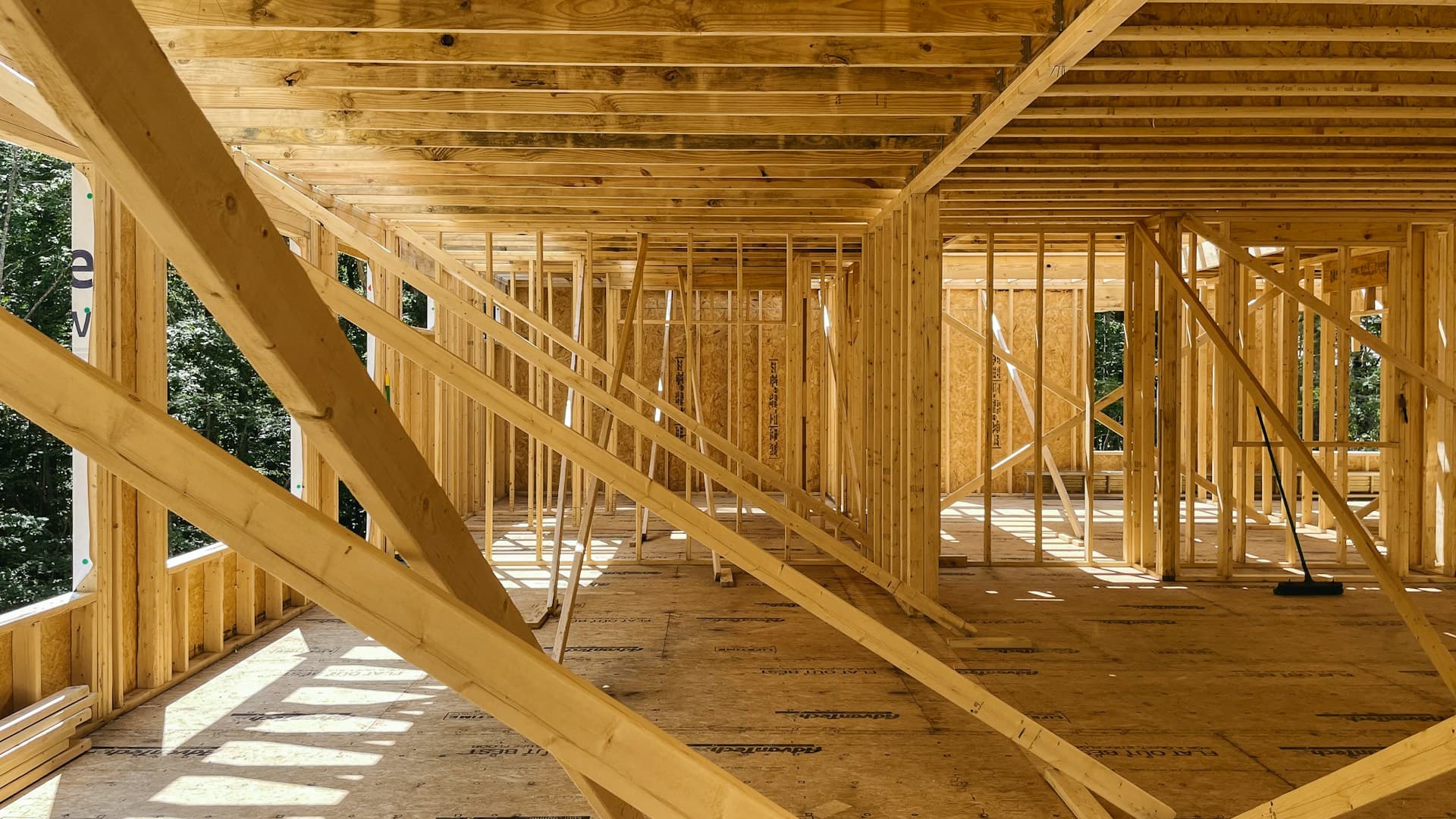
Timber Wall Framing
Assembly and erection of timber wall frames for residential construction including measuring, cutting, assembly on slab, nailing with pneumatic framing nailer, wall raising/standing, temporary bracing, and tie-down installation. Covers controls for nail gun injuries (sequential trigger mandatory), circular saw kickback, working at heights on top plates, manual handling of long timber, struck-by hazards during wall raising, and noise exposure. Pre-filled hazards, controls, and risk ratings.
Wall raising is the single most-photographed moment on a residential build, and it's also the one that produces the highest acute injury count on a framing crew. A 6-metre studwall full of openings, plates and windows weighs more than four blokes can comfortably hold against the wind for the time it takes to plumb and brace, and the temporary diagonal bracing called for in AS 1684 is the difference between a wall that stays where you put it and one that drops on the slab. Permanent design bracing comes later in the sequence — the standard distinguishes the two, and crews that conflate them lose half a day's work to a frame collapse.
Once the wall is up and the next storey starts, the fall hazard goes from "edge of the slab" to "top plate at 2.7 metres", and the Model Code of Practice on Managing the Risk of Falls in Housing Construction drives the next set of controls. Physical fall prevention above 2 metres — perimeter scaffold to AS/NZS 1576.1:2019, edge protection, or fall arrest under AS/NZS 1891.1:2020 — replaces "watch where you stand". Sequential-trigger framing nailers stay in sequential mode; bump-fire is what puts apprentices in emergency departments.
Two state-context items round out a framing SWMS. Cyclonic regions C and D under AS/NZS 1170.2:2021 drive substantially heavier tie-down detailing than non-cyclonic N3/N4 zones, and crews moving north from Brisbane routinely under-fix when they get to Cairns. Cert III in Carpentry under CPC30220, a current White Card and a fall arrest refresher complete the operator's qualifications; the bracing call before lunch is the one that determines whether the afternoon is productive or spent re-erecting.
What's In Your SWMS
7 Hazards & Controls
Penetrating wounds (hands, feet, legs, eyes), severed tendons, nerve damage, bone fractures, eye injuries from ricochet, infection, death (rare - penetrating wounds to torso/head)
Use pre-fabricated wall frames (nailing done in factory with fixed jigs) where project allows
SEQUENTIAL TRIGGER NAILERS ONLY - contact/bump fire triggers are prohibited. Sequential triggers require deliberate action for each nail, eliminating accidental discharge.
Establish nail gun exclusion zone - no unauthorised persons within 3m of active nailing. Post warning signs.
- Sequential trigger mechanism on all framing nailers (non-negotiable)
- Nail gun must have functioning safety tip and trigger guard
- Connect to air supply with correct pressure (as per manufacturer - typically 80-120 PSI)
- Anti-double-fire mechanism must be functioning
- All operators must be trained in safe nail gun operation before use
- Apprentices may only use nail guns under direct supervision of licensed carpenter
- Inspect nail gun before each use: safety tip, trigger mechanism, hose connections
- Keep finger OFF trigger when moving between nailing points
- Never carry nail gun with finger on trigger
- Inspect timber for knots, existing nails, and cracks before nailing (ricochet hazard)
- Never fire nail gun above shoulder height
- Position body to side of nail line - never in line with potential ricochet path
- Disconnect from air supply when not in use, during jams, and when leaving unattended
Impact-rated safety glasses (AS/NZS 1337) at all times during nailing. Steel cap boots with puncture-resistant sole. Hard hat during wall raising. Cut-resistant gloves.
16-Step Work Procedure
Equipment & PPE
Equipment (14)
- Pneumatic framing nailer (SEQUENTIAL TRIGGER ONLY)
MUST have sequential trigger mechanism (not contact/bump fire). Contact triggers cause most nail gun injuries. Check trigger type before use. 75-90mm framing nails.
- Air compressor and hoses
Appropriate capacity for framing nailer. Check hose connections for leaks. Drain moisture daily. Safety valve functioning.
- Circular saw (185mm or 235mm)
Blade guard must be functioning. Check blade for damage before use. Riving knife in place. Use correct blade for timber type.
- Drop saw / mitre saw
For cross-cutting studs, plates, and noggings to length. Blade guard must function. Secure to stable bench.
- Scaffolding or trestle scaffold
Required for upper storey framing and any work above 2m. Erected to AS/NZS 1576. Guardrails, mid-rails, and toe boards required.
- Extension ladder and step ladder
Industrial rating (120kg minimum). Ladder to extend 1m above landing. Secured at top. 4:1 angle ratio. Three-point contact.
- Spirit level (1200mm and 1800mm)
For checking plumb on studs and walls. Laser level for datum lines.
- Tape measures (8m) and builders square
For measuring and marking timber and checking wall squareness.
- Chalk line and marking tools
For marking plate positions on slab and stud locations on plates.
- Framing hammer (20-24oz)
For adjustments, persuading timber into position, and hand nailing where nailer cannot reach.
- Crowbar and pry bar
For adjusting wall positions, removing temporary bracing, and corrections.
- Temporary bracing timber and brackets
Must be adequate to resist construction wind loads per AS 1684. Install before wall raising. Secured at top of wall and anchored to slab.
- Extension leads with RCD protection
Heavy-duty construction leads. RCD protected (max 30mA). Test and tag current. Keep clear of cutting area.
- First aid kit
Include wound dressings for penetrating injuries, eye wash, splinter removal tools, and burn treatment.
PPE (7)
- Safety glasses (impact rated)AS/NZS 1337.1:2010
MANDATORY during all nailing, cutting, and hammering. Impact rated for nail ricochet and timber chip protection.
- Hearing protection (Class 5)AS/NZS 1270:2002
Required during nail gun, circular saw, and drop saw operation. Impulse noise from nail guns can cause instant hearing damage.
- Safety footwear (steel cap, puncture-resistant sole)AS 2210.3:2019
Steel cap for dropped timber and tools. Puncture-resistant sole for nail penetration protection on slab with offcuts.
- Hard hatAS/NZS 1801:2024
Required during wall raising (struck-by risk), working below elevated workers, and when crane/telehandler operating.
- Work gloves (cut-resistant)AS/NZS 2161.3:2020 (mechanical risks); AS/NZS 2161.1:2016 (general)
Cut-resistant gloves for timber handling (splinters, rough edges). Remove when operating circular saw to prevent entanglement.
- Sun protection (hat, long sleeves, sunscreen)
Wide-brim hat or hard hat with brim and neck flap. Long-sleeved UPF 50+ shirt. SPF 50+ sunscreen every 2 hours.
- P2 dust maskAS/NZS 1716:2012
Required when cutting treated timber (CCA/ACQ). Wood dust is classified as carcinogenic (IARC Group 1). Use during prolonged cutting operations.
Training & Emergency
Competency Requirements
- Construction Induction Card (White Card)training
Required for all workers on construction sites. CPCCWHS1001 - Prepare to work safely in the construction industry (supersedes the legacy CPCWHS1001 code).
- Carpentry Contractor Licencelicence
Required in all Australian states for carpentry work. NSW: required for work over $5,000. Underpinned by Certificate III in Carpentry (CPC30220).
- Certificate III in Carpentry (CPC30220)certificate
Nationally recognised trade qualification for carpentry. Covers framing, fixing, formwork, and general carpentry skills.
- Working at Heights Training (RIIWHS204E)training
Required for all workers working above 2m. Covers fall prevention, harness use, and rescue procedures. Refresh every 2-3 years (industry best practice).
- Nail Gun Safe Operation Trainingtraining
All nail gun operators must receive training covering safe operation, trigger types, PPE, and malfunction procedures. Apprentices may only use under direct supervision.
- First Aid Certificate
Recommended for at least one team member. HLTAID011 Provide First Aid. Critical given penetrating wound and fall risks.
- Scaffold User Awareness Training
Required for workers using scaffolding. Covers safe access, daily inspection, and load limits. Erection requires licensed scaffolder.
Emergency Procedures
NAIL GUN PENETRATING WOUND: Do NOT remove embedded nail. Stabilise nail in position. Apply pressure around wound. Call 000. If nail has penetrated torso, chest, or head - call 000 immediately as life-threatening emergency.
CIRCULAR SAW KICKBACK INJURY: Apply firm pressure to laceration with clean dressing. If arterial bleeding (bright red, pulsing), apply tourniquet above wound and call 000 immediately. Note time of tourniquet application.
FALL FROM HEIGHT: Do NOT move patient if spinal injury suspected. Call 000. Keep patient still and warm. Clear area around patient. If harness arrest has occurred, suspension trauma symptoms can develop within 5–30 minutes — target rescue within approximately 15 minutes. Once the worker is clear of suspension, place them in a flat / supine position (or recovery position if unconscious and breathing) per ANZCOR Guideline 9.1.5; the earlier advice to keep rescued workers upright after rescue has been retracted.
WALL COLLAPSE / CRUSH INJURY: Call 000 immediately. Do NOT attempt to lift wall off patient unless trained in rescue. If patient is conscious and breathing, keep them calm and still. Bystanders to stabilise remaining walls to prevent further collapse.
HEAT STROKE: Call 000 immediately. Move person to shade. Remove excess clothing. Cool rapidly with water and ice packs to neck, armpits, and groin. Do not give fluids if confused or unconscious.
Everything above, included in your SWMS document.
Get This TemplateWriting a SWMS from scratch?
That's 2-4 hours of research, formatting, and cross-referencing regulations.
We've done the starting work — pick your template, add your details, review.
Or just do this:
- Unlimited documents
- All 70+ templates
- Instant PDF & DOCX
- Cancel anytime
High-Risk Construction Work Categories
Under Australian WHS Regulations (Section 291 - High Risk Construction Work; Chapter 6 Part 6.5 - Falls; Chapter 7 Part 7.2 - Noise), this work is classified as high-risk due to:
- Risk of falling more than 2 metres (Workers stand on top plates and scaffolding during upper storey framing, tie-down installation, and bracing. Fall from top plate height (2.4-3.0m) exceeds 2m threshold.)
- Temporary support for structural alterations (Temporary bracing required during wall raising and until permanent bracing is effective. AS 1684 requires temporary bracing design for construction loads.)
Australian Standards Referenced
National Guidance Documents
- Safe Work Australia - Model Code of Practice: Construction Work
- Safe Work Australia - Model Code of Practice: Preventing Falls in Housing Construction
- Safe Work Australia - Model Code of Practice: Managing Noise and Preventing Hearing Loss at Work
- Safe Work Australia - Guide to Scaffolds and Scaffolding Work
- Safe Work Australia - Model Code of Practice: Hazardous Manual Tasks
- WoodSolutions - AS 1684 User Guide: Temporary Bracing
Who Needs This SWMS?
This template is designed for the following trades and roles performing timber wall framing work.
Frequently Asked Questions
What type of nail gun trigger should be used for framing?
Sequential trigger (single-shot) nail guns only. Contact/bump fire triggers cause significantly more injuries and are not recommended by Safe Work Australia or state regulators. Sequential triggers require the safety tip to be depressed first AND the trigger squeezed for each nail, preventing accidental discharge. This is the single most important safety control for framing nailer use.
How many workers are needed to raise a wall frame safely?
Minimum 3-4 workers for standard residential walls (2.4-3.0m high, standard pine framing). Longer walls over 4m or heavier hardwood frames require 5-6 workers. One worker should act as supervisor directing the operation. Never position any worker between the wall and a fixed structure during raising. Temporary bracing must be secured to the slab immediately when the wall reaches vertical.
Do carpenters need a licence in Australia?
Yes. Carpentry is a licensed trade in all Australian states. The underpinning qualification is Certificate III in Carpentry (CPC30220). In NSW, a Carpentry Contractor Licence is required for work valued over $5,000 in labour and materials (including GST). A builder's licence is also required for general residential building work. Licensing requirements vary by state.
What training is required for working at heights during framing?
All workers working above 2m must hold current Working at Heights training (RIIWHS204E). This nationally recognised unit of competency covers fall prevention, harness selection and use, and rescue procedures. Standard course is 1 day. Industry best practice is to refresh every 2-3 years, and most principal contractors require current training.
What are the temporary bracing requirements during framing?
AS 1684 requires temporary bracing to be installed during construction. Bracing must resist construction wind loads, which can equal or exceed final clad loads. Bracing should be installed on wall frames before raising, at minimum 45-degree angle, secured at the top plate and anchored to the slab with bracing brackets. Temporary bracing remains in place until permanent bracing is confirmed effective.
Is treated timber dust hazardous?
Yes. Wood dust is classified as carcinogenic to humans (IARC Group 1). Treated timber (CCA or ACQ) contains additional hazardous chemicals including copper, chromium, and arsenic (CCA) or quaternary ammonia (ACQ). P2 respirators are required during prolonged cutting of treated timber. Never burn treated timber offcuts - dispose of appropriately.
Can apprentices use nail guns?
Apprentices can use nail guns ONLY under direct supervision of a licensed carpenter. They must receive training in safe operation including sequential trigger operation, PPE requirements, and malfunction procedures before any use. Unsupervised nail gun use by apprentices is not permitted.
How do cyclonic-region tie-down requirements differ from non-cyclonic?
AS/NZS 1170.2:2021 divides Australia into wind regions A, B, C and D, with C and D the cyclonic regions covering coastal areas from Carnarvon north and around to roughly Bundaberg. Cyclonic-region framing under AS 1684 requires substantially heavier tie-down detailing than non-cyclonic N3 or N4 — multi-grip strapping at every truss, full-length tie-down rods through the frame, and stud-to-plate fixings rated for the wind uplift load. Crews moving from temperate to cyclonic regions routinely under-fix because the detailing isn't intuitive — and insurance claims after cyclones flag the under-detailing predictably. Check the wind region and the engineering certification before cutting plate.
What's the bracing distinction between temporary and permanent in AS 1684?
AS 1684 distinguishes temporary construction bracing — diagonal members fixed during the build to keep a half-raised wall plumb until it's tied into permanent structure — from permanent design bracing, which is the calculated wall bracing that resists wind and earthquake loads on the finished building. They're not the same. Temporary bracing comes off after the wall is tied in and the permanent bracing is fixed; permanent bracing stays for the life of the building. Skipping temporary bracing on the assumption "the wall isn't going anywhere" is the cause of the single-frame collapses that show up in WorkSafe injury data — a 6-metre studwall full of openings dropping during a gust on the slab.
How do you prevent circular saw kickback?
Stand to the side of the blade - never directly behind the cut line. Support material on both sides of the cut to prevent blade pinching. Ensure blade guard is functioning and returns automatically. Keep riving knife installed and adjusted. Use correct sharp blade for the material. Let blade reach full speed before contacting material. Do not force the saw. Remove gloves when operating to prevent entanglement.
Get Your Timber Wall Framing SWMS
Pre-filled. Risk-rated. Ready in 5 minutes.
Get Your SWMS PDFNo credit card required. First SWMS is free.
